How to study for a physics assessment

Ok, so if you check the course calendar, you'll see that you have your first assessment in physics coming up next week. How should you study? Read carefully for my step-by-step guide to demonstrating deep understanding

Big picture of what you're doing:

  1. Get out your copy of the Major Concepts for Unit 2. Read these through, and circle anything that seems completely unfamiliar to you.
  2. Remember the purpose of this assessment. I am looking to help you see how well you understand these ideas. You can help yourself tremendously, by figuring out, before the test, how well you understand these ideas and making sure you master them.
  3. While you study, your job should be to find/create problems that test these major ideas, try them, and then trouble shoot your work until you master the concept.

Step by step of what you should do:

  1. Get a bunch of blank sheets of white paper or graph paper (if you're making/interpreting graphs).
  2. Copy problems that we've done in class, on homework, and on webassign onto a a sheet of paper (one problem per page). Don't copy your answer from class notes.
  3. Try to figure out which of the Major concepts this problem is testing, and write that at the top of the page.
  4. Solve the problem. Try to do it in as much detail as possible. If you get stuck, write out a sentence explaining what you don't understand. The check the solution, and finish the problem. Recopy this problem and put it back into your stack of problems you're working on.
  5. Keep working through problems until you've successfully mastered one or more problems from each topic.
  6. Check yourself for small errors, like omitting units, writing bogus numbers, calculating slope as x/t, etc. Make a note of these on the problem, and focus on not making this mistake the next time you solve a similar problem.
  7. If you can't find a problem from your notes or homework, this is a sign your understanding of this topic is incomplete. You can find additional problems in the text, or online by googling for them. You can also email me.
  8. If you get stuck on a problem or concept, you are welcome to email me or schedule some time during backwork or a free period. But I also encourage you to use the blog to help increase your understanding as well (see below).
  9. When you're done, you should have a small booklet of 10-20 problems that clearly show mastery of each topic.

    In practice, this doesn't take nearly as much time as you might think. With four days between now and the assessment, you can spend 10-15 minutes working out problems for 5 concepts per night, and have covered all 15 concepts by Thursday night, giving you Thursday night to go back over any last remaining concepts you're slightly unclear on.

    Using the class blog to ace a physics test


    If you find yourself stuck on a particular concept or problem, I encourage you to use the class blog to help you find the answer. Just create a new post (label it "reflection") and describe your problem "I can't see how to solve problem 2.4," or "I don't know how to draw a position vs time graph from a velocity vs time graph." Doing so will do a number of things:

    1. Just explaining what you don't know will often lead to greater understanding.
    2. You writing about a problem will help your peers to these themselves on what they understand.
    3. You will be contributing to the class community, and this will positively impact your grade (both intangibly and tangibly).


    Likewise, if you know the answer to a question posted by a peer, I encourage you to comment and leave a response. This will positively influence your grade.

    More tips:

    1. The science of studying, from Study Hacks

August 31, 2009

Today we started class by discussing constant velocity and constant acceleration. The equation for constant velocity is X(T)=VT+Xo. Constant velocity is an object moving at a constant speed and direction. The equation for constant acceleration is Xf(T)=Xo+ViT+1/2AT^2. Constant acceleration is when an object's velocity is moving at a constant rate.
After we discussed constant velocity and acceleration, we divided up into groups and made constant position vs. time graphs and constant velocity vs. time graphs.
At the end of class, we worked on our motion detector lab. For homework, we are supposed to finish Homework 2B and work on Homework 2C. This homework has to do with measuring velocity and acceleration. The scribe for Tuesday is...Paxton.

All your excel problems solved

So by now, you've had a chance to get frustrated with excel, and wonder why such a powerful tool would be so difficult to use. Fear not. I've made the following quick (<4 minutes each) tutorial videos that should explain the basics of excel and get you back on track right away.

1. Basics (making the data table)


2. Graphing (making x vs t graph, and then making it pretty--labels, title, etc)

3. Linearizing (making x vs t^2 graph)

4. Double interval method (finding instantaneous velocity values and making graph).


If you still have questions, post a comment on this blog and we'll see if someone in the class has the answer.

ps. I created these videos in less than 30 minutes using the super awesome program jing. check it out!

The Big Bang Explained

AB660C5F-DF75-4337-AF42-80A837376CDA.jpg
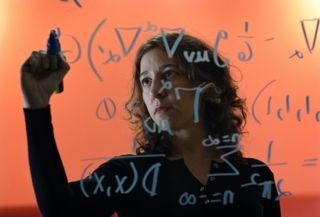
Ever wonder what the big bang is all about? What a multiverse is? This 2 minute video gives a great explanation by physicist Janna Levin, who is also a fantastic author. She wrote How the Universe got is Spots, and the award wining fiction book, A Madman dreams of Turing Machines. Both are great, quirky reads.


Class notes for Friday, August 28

When class started on Friday, we reviewed homework 2b. Mr. Burk explained to us that the area in a velocity vs. time graph represents the displacement. THe slope in a velocity vs. time graph is the change in velocity over the change in time. THe change in velocity is found by subtracting the initial velocity from the final velocity.
We then talked briefly about the corrections policy. Mr. Burk asks that we generally turn in our corrections within a week. It is perfectly fine if you choose to not make corrections. Talk to Mr. Burk if you have any questions.
Next Mr. Burk talked about some of the big ideas from Wednesday's class. The position vs. time graph of the falling basketball made a parabola, while the grpah of position vs. time squared made a straight line. A square root of the position vs. time graph would have also made a straight line.
Mr. Burk spoke with us about the double interval method. The double interval method is used for estimating instanteneous velocity. You make a position vs. time data table and then find the change between those points. Average V=change in x/change in t. You want to make this as small as possible. The double interval method gets you a line closer than average velocity because you use two intervals instead of one.
After this we broke into groups and did the Understand the Motion Sensor lab. We will finish this lab during the next class. Our homework was to finish the last 2 pages of homeowork 2B, complete the weekly evaluation on webassign, reread 2.7, and do the basketball lab. Don't spend more than 10 minutes making the graph on excel. Email Mr. Burk if it takes you any longer. Monday's scribe will be.... Eliza.

mary elizabeth

The art of taking notes in science class

Have you wondered exactly how you should take notes in physics to achieve the deepest understanding? You're not the first to ask the question, and not surprisingly, the author of Study Hacks has a few things to say about the art of taking science notes.

Notice that this post talks about going over your notes, but not just re-reading them, instead, it suggests you work to recopy/add to your notes so that you can develop a set of notes that can re-teach you the material in 10 years.

This can be a LOT of work, and I would encourage you not to do this for everyday we take notes, but if there's a time when we're covering something that seems particularly difficult, it might be a good exercise to try to go back and recopy and improve your notes.

Here are a few more tips from a college professor of geology.

Beautiful time lapse of Persied Meteor shower

Sometimes, physics begins with just admiring the beauty of the world around us. Check out what you see if you spend a night taking photos of the sky during the Perseid meteor shower. To get a explanation of what you're looking at, check out the always great, Bad Astronomy. Be sure to click on the HD link to see this movie in all its glory.