One of the most mind-boggeling, thought-provoking, get students to completely change their conception of thinking, math and more, is
Godel, Escher, Bach.
And best of all MIT has created a free class based on this book, complete with lectures, notes and more.
If you undertake this journey, the rewards will be immense, and you'll certainly have your mind blown more than once.
March 1st
The big idea for today that as the radius of a planet increases, its centripetal acceleration decreases. Also, the acceleration of the earth divided by its radius squared is almost the same as the acceleration of the moon. I think.
0
comments
Monday, March 1, 2010


Friday, February 26
Today in class we had a double period that consisted of meetings with Mr. Burk for about 25 minutes about the projects, and working on them while other groups met. The big idea for projects is looking ahead and finding something new to master.
Hw:6d and webassign, work on project
Scribe is Mary Elizabeth
Hw:6d and webassign, work on project
Scribe is Mary Elizabeth
0
comments
Friday, February 26, 2010
last wed class
First we took a blast from the past energy re assessment , and then we talked more about the moons lab, and finally we worked with the vandegraf generator.
Important ideas were that objects will repel each other when on the vandegraf and that to linierize the orbital period vs radius, you need to raise the radius to the 1.5 power.
next scribe is Burge.
Important ideas were that objects will repel each other when on the vandegraf and that to linierize the orbital period vs radius, you need to raise the radius to the 1.5 power.
next scribe is Burge.
0
comments
Thursday, February 25, 2010
2/22/09
Today in class we went over 6c and did a problem in class.
The problem was with a square where one side has a length of 0.5 meters and all the charges are equal and are +or- depending on the charge of the point and is equal to 50*10^-6:
1)Find Fe on 1
2)Find E at location of i
3) Find any place(s) where the electrical field vector is 0
4)Find E at A
5)What force would a -20muC charge feel at A?
DYLAIN scribes next
0
comments
Monday, February 22, 2010
Class on 2-17
Today we worked on our projects. Homework was 6c. The next scribe is Paxton.
0
comments
Thursday, February 18, 2010
Class 2/16/10
Today in class we talked mostly about Coulombs law. Coulomb's law is basically an equation that states that Fe=(k*q1*q2)/r^2. We also learned that constant K always equals 9*10^9. Using this information, we can find Fe as long as we know the charge of 2 objects and their seperation distance!
1.) If we find out the net charge of an object and divide it by the charge of an electron (always 1.6*10^-19) we can find out how many excess electrons there are.
2.) Also, one atom has an area of 4*10^20 so if we divide the area of the object by that number we get how many atoms there are overall.
If we divide (1) by (2) we can find how many electrons were transferred when the object was charged! yaaay..
(I tried to keep it short and sweet :]) next scribe is Joe!
0
comments
Tuesday, February 16, 2010
Happy Valentine's Day--seeing hearts
Labels:
cool stuff,
Mr. Burk
Here's a really cool video that shows just how much we are pattern seeking animals. We can find hearts anywhere.
0
comments
Sunday, February 14, 2010
2/8/10 class!

Today we reviewed the ideas of 6A and then checked 6B which led to us talking more about polarization. There wasn't a main idea of the class today but I guess I will talk about a problem in 6B that will help with understanding polarization more. In 2b in 6B to get equal opposite charges:
1. touch the two spheres together
2. rub the paper to the plastic making it have a negative charge.
3. bring the negatively-charged plastic to the spheres but don't touch them
4. the charges in the spheres will separate and the positive charges will go into the sphere closest to the plastic because opposites attract and the negative charges will go into the sphere farthest away from the plastic because the same charges repel.
5. Separate charges and spheres
2
comments
Monday, February 8, 2010
2/2/10 Class
Labels:
Scribe Posts
Today, we wrapped up kinetic and potential energy and began our exploration into electrostatic force.
We finished off Chapter 5 with one last problem involving a bungee jumper jumping off a cliff. Using the given information, we had to calculate various things such as the max velocity, the point of max velocity, and the spring constant of the bungee cord. The big insight used to solve this problem was realizing that .png) . Using this, you can set
. Using this, you can set 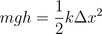.png) to find the spring constant of the bungee cord and through that the rest of the answers.
to find the spring constant of the bungee cord and through that the rest of the answers.
.png) . Using this, you can set
. Using this, you can set .png) to find the spring constant of the bungee cord and through that the rest of the answers.
to find the spring constant of the bungee cord and through that the rest of the answers.After a short break, we began our journey into the wonders of electrostatic force with a hands-on experiment involving "magic" tape. We put layers of tape on the desks and quickly ripped the top layer off and observed the way this top layer of tape interacted with its surroundings (i.e. other pieces of tape, paper, etc.). When two top tapes came in proximity with each other, they tended to repel each other, demonstrating a new type of force: electrostatic force. Other properties of the tape we observed was that it attracted pieces of tape from the bottom, rather than repelling them. Mr. Burk also showed us similar interactions between a plastic rod and paper as well. This energy comes from the displacement of electrons in the objects being rubbed together; when electrons (which are negative) are lost or gained, the charge of that corresponding object becomes more positive or more negative. When two objects have opposite charges, they will attract each other.
That's what we did in class today. Next scribe is Margaret.
0
comments
Tuesday, February 2, 2010
Big idea for Feb. 1, 2010
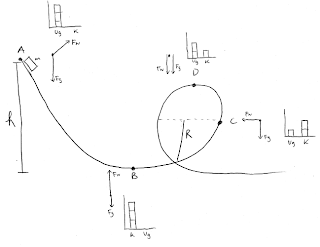
Today's main topic was applying energy to the motion of a roller coaster car as it goes along the track and does a loop-de-loop. Mr. Burk presented us with a problem requiring us to apply energy transferring, centripetal motion, and FBD presentation to solve.
The drawing for the problem is this:

The problem that Mr. Burk presented us with is as follows:
1) Find the speed of the car at points A, B, C, and D.
2) Find the minimum speed to make the loop.
3) Find the minimum height the car was dropped from to make the loop.
4) Construct an FBD for points A, B, C, and D.
The answers are as follows:
1) a. V=0 because the object is at the top of the course.
b. all of the Ug the car started with has now transfered into K
so mgh=.5*mv^2
v=square root(2gh)
c. the equation is the same except the height is now h-R
so v=square root(2gh-2gR)
d. the equation is the same except the height is now h-2R
so v=square root(2gh-4gR)
2) the centripetal acceleration is v^2/R and acceleration is Fnet/m.
so Vmin^2/R=mg/m
Vmin^2/R=g
Vmin=square root(Rg)
3) for the car to make the loop, the velocity at D squared is equal to mg/g*R because of the fact that the centripetal acceleration equals the def. of acceleration (see #2)
so 2gHmin-4gR=gR
2gHmin=5gR
Hmin=2.5R
4) the FBDs and diagrams for the car are below:
The drawing for the problem is this:
The problem that Mr. Burk presented us with is as follows:
1) Find the speed of the car at points A, B, C, and D.
2) Find the minimum speed to make the loop.
3) Find the minimum height the car was dropped from to make the loop.
4) Construct an FBD for points A, B, C, and D.
The answers are as follows:
1) a. V=0 because the object is at the top of the course.
b. all of the Ug the car started with has now transfered into K
so mgh=.5*mv^2
v=square root(2gh)
c. the equation is the same except the height is now h-R
so v=square root(2gh-2gR)
d. the equation is the same except the height is now h-2R
so v=square root(2gh-4gR)
2) the centripetal acceleration is v^2/R and acceleration is Fnet/m.
so Vmin^2/R=mg/m
Vmin^2/R=g
Vmin=square root(Rg)
3) for the car to make the loop, the velocity at D squared is equal to mg/g*R because of the fact that the centripetal acceleration equals the def. of acceleration (see #2)
so 2gHmin-4gR=gR
2gHmin=5gR
Hmin=2.5R
4) the FBDs and diagrams for the car are below:
That is the entire insightful problem. HW: e-mail proposal to Mr. Burk and work more on the energy packet. Next Scribe: Timothy!!
0
comments
Monday, February 1, 2010
You CAN change the world
Never doubt that a small group of thoughtful, committed, citizens can change the world. Indeed, it is the only thing that ever has.
--Margaret Mead
Boy, 7, raises $240,000 for Haitian Relief.
0
comments
Tuesday, January 26, 2010
Tonight's (1/25/10) Homework
Hey guys, I was having a little bit of trouble with 2c (see how Kinetic Energy vs. Distance Fallen graph and Gravitational Force vs. Distance Fallen graph help to define Gravitational Potential Energy). I feel like Gravitational Force and Gravitational Potential Energy are kind of the same thing... I'm kind of confused about the difference between the two/the 2c question in general if you couldn't tell already. Anything would help, please comment! Thanks so much!
1 comments
Monday, January 25, 2010
Hard problem 3
Labels:
Mr. Burk
Hard problem 2 is dead——if you helped solve it, be sure to claim your propsicle.
Hard problem 3 can be found here.
Hard problem 3 can be found here.
An important point about 5C
Labels:
class follow up,
Mr. Burk
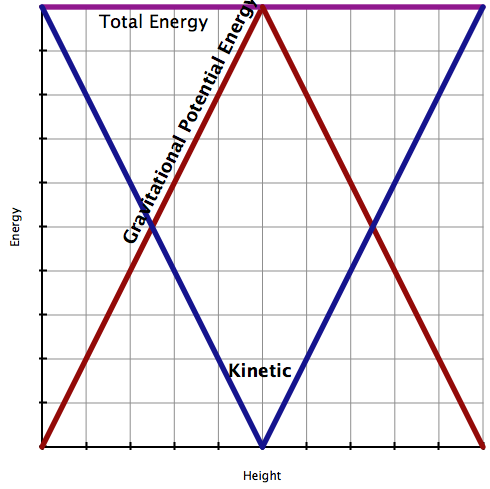
A very important point came up today when a few students were discussing 5c. The question was which of the following two graphs is the right answer. It turns out the bottom graph is right. Why?

2
comments
Wednesday, January 20, 2010
Big Ideas from 1/20
We discovered big understandings from force vs. displacement graphs and energy vs. position graphs. The area in a force vs. displacement graph is work. The work done by the spring force is - 1/2(k) (change in x)^2.
Energy depends on displacement, and a large displacement leads to a large energy. A small displacement leads to a small energy. For the kinetic energy vs. displacement graph, the total energy was constant. The difference between the total energy and the kinetic energy is the potential gravitational energy.
Energy depends on displacement, and a large displacement leads to a large energy. A small displacement leads to a small energy. For the kinetic energy vs. displacement graph, the total energy was constant. The difference between the total energy and the kinetic energy is the potential gravitational energy.
Class on Friday Jan. 15th
In class on Friday we talked about how to go about solving energy problems. Mr. Burk gave us some steps:


Guidelines For Energy Problems
1) Start by defining a system
2) Give symbols meaning (ex: instead of looking at a symbol like  K and thinking of it as just K, think of it as change in kinetic energy)
3) Do everything symbolically
Also in class, we talked about power.
Also,
Power is measured in Joules per second or Watts. 1 Joule per second=1 Watt
Homwork is to finish 5C
Monday's scribe is... Jason
0
comments
Monday, January 18, 2010
Today in class...
Today, we started class by discussing how a single point particle can be thought of as a piggybank. and money as a whole is considered energy. i thought that was a cool analogy!!
Energy is put into an object, but then it must leave the object at some point. if more energy is put into an object than the amount that leaves, the object is gaining energy. if more leaves an object, it is losing energy.
Then, we looked at our graphs. K should be between 400N/m and 800N/m. The force of the spring is opposite the stretch. Just as a review: work equals force times change in displacement. (W=F*change x)
Homework is to finish 5b and start 5c. tomorrow's scribe is Sana!!
0
comments
Wednesday, January 13, 2010
Subscribe to:
Posts (Atom)